A few years ago, I watched a group of ten-year-olds working on tablets. They were sitting together and editing the same document, but they weren't looking at one another. The task was described as collaborative. I found myself wondering what they were actually learning about working together.
It would be unfair to conclude that nothing useful was happening. Children can collaborate through writing, and a quiet classroom can be a place of concentration. Still, sharing a document doesn't tell us whether students are considering each other's ideas or simply completing separate sections. We have to look more closely at the work.
Check the learning
I think we sometimes give technology credit for learning we haven't checked. A completed activity, a higher score, or a colourful dashboard can look reassuring. A conversation with the student may tell us something different. Can they explain how they arrived at the answer? Can they use what they practised when the format changes?
Those questions apply to paper tasks as well. A worksheet can keep a child occupied without helping them understand very much. The medium alone won't settle the quality of the teaching.
The Education Endowment Foundation's guidance on digital technology recommends considering how a tool will improve teaching and learning before introducing it. Its examples include improving assessment and the quality or quantity of practice. That is a more useful basis for a decision than whether a tool looks innovative.[1]
What the tool adds and asks
I use technology daily, and there are things I would be reluctant to lose. A video journal can give a student a way to explain their thinking. Translation tools can help someone participate in a conversation that would otherwise be less accessible. Digital resources can also make it much easier for teachers to prepare materials and adapt them for a class.
But a tool can solve one problem and introduce another. Recording a reflection takes time; uploading it takes more. We need to consider whether somebody will listen and respond. A digital quiz may help identify an error quickly, but the teacher still needs to work out what the error means and what to do about it.
Make room for other experiences
In primary classrooms, I also want to protect time for children to talk, handle materials, and work through disagreements with other people. Those experiences need space in the day. If a device takes over part of that time, I want a clear reason for the trade.
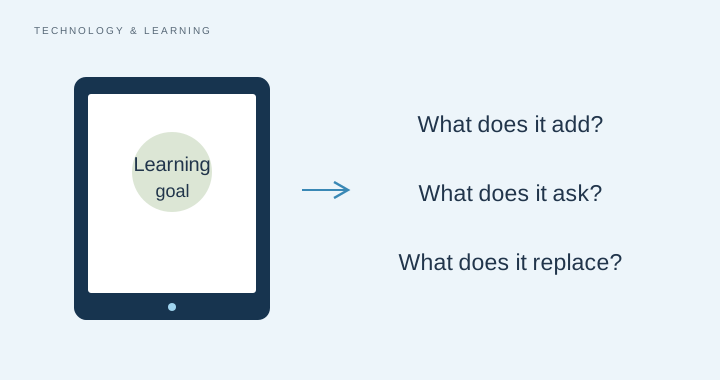
This leaves me with a fairly practical approach. Start with what students need to learn. Consider what the technology adds, what it asks of them, and what it replaces. Then pay attention to whether it helps.
Sometimes the device will be the right choice. Sometimes we will get further by putting it away and asking students to explain their ideas to the person beside them. I want to be able to make either decision without having to defend it as a position on technology in general.
References
Written by Tim Van Der Merwe.
Continue the conversation ↗